
Sharing AI Development Rules Across Your Organization
How centralized-rules achieved 74.4% token savings and consistent AI behavior with progressive disclosure and context-aware rule loading.

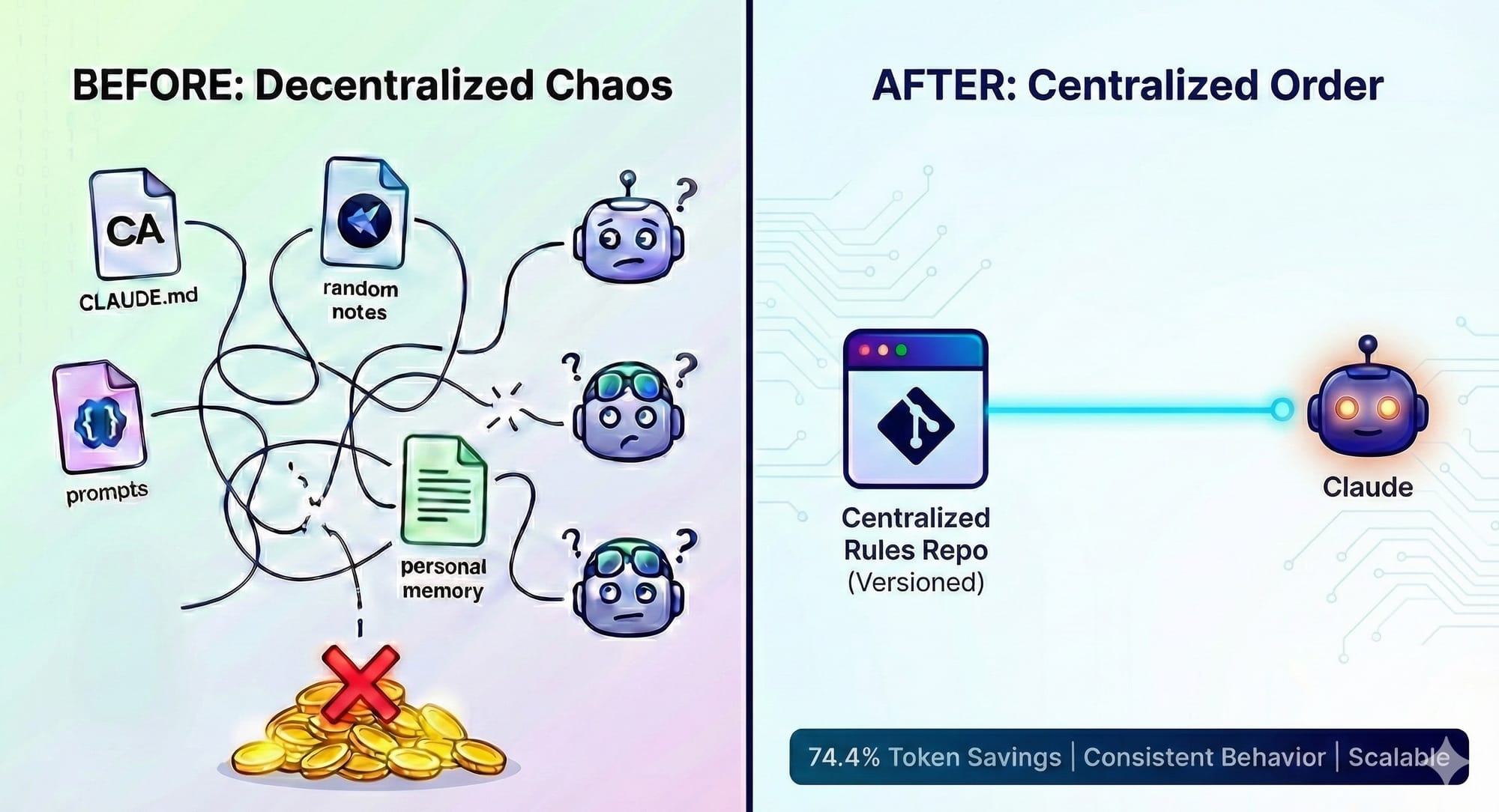
Every developer on your team likely has their own AI rules file. One person's CLAUDE.md says "always write tests." Another's says "use TypeScript strict mode." A third developer just copies whatever worked on their last project. Meanwhile, your AI coding assistants—Claude Code, Cursor, GitHub Copilot, Gemini—are getting inconsistent instructions across every project and every person.
This is the AI rules governance problem, and at scale, it's costing you tokens, consistency, and quality. A central CLAUDE.md file can help, but it quickly bloats when you try to cover every scenario—and worse, it can't be specific to your particular environment or project. The AI may not even read all of it.
I built centralized-rules to solve it, based on the centralized-rules pattern I've been experimenting with. After two months of using this approach in my own work, the result: 74.4% token savings and consistent AI behavior that scales across teams.
The Enterprise AI Rules Problem
AI coding tools are now common across development teams. But each tool needs configuration to perform well—Claude Code uses CLAUDE.md and .claude/ directories, Cursor uses .cursorrules, and other tools have their own configuration patterns.
Without centralization, you get:
- Tribal knowledge: Best practices live in individual developers' heads (and their personal config files)
- Copy-paste chaos: Teams share rules via Slack, and they drift immediately
- Onboarding friction: New developers spend days figuring out "how we do AI here"
- Token waste: Loading all rules when you only need a subset for your specific context
With hundreds of developers across teams, this becomes ungovernable. You can't audit what instructions your AI tools are receiving. You can't ensure security rules are consistently applied. You can't measure whether your AI development standards are actually being followed.
The Solution: Centralized Rules with Progressive Disclosure
The core insight is simple: one source of truth, versioned in Git, with context-aware loading.
Instead of every developer maintaining their own rules, you maintain a single repository of AI development rules. But here's the key—you don't load all of them all the time. That would overwhelm the AI and waste tokens.
Instead, the system uses progressive disclosure—a technique that loads only relevant rules based on context:
- Detect context: Scan the project for language markers (
package.json,pyproject.toml,go.mod) - Match keywords: Analyze the prompt for task-specific terms (test, security, refactor)
- Display banner: Show which rules apply to the current task
- Apply rules: AI follows only the relevant coding standards
The rules themselves are organized in a four-dimensional structure:
- Base: Universal rules that apply to all projects (git workflow, code quality, security principles)
- Language: Language-specific rules (Python, TypeScript, Go, Java, C#, Rust)
- Framework: Framework-specific rules (React, Django, FastAPI, Express, Spring Boot)
- Cloud: Cloud provider rules (AWS, Vercel, with Azure and GCP extensible)
This follows the MECE principle (Mutually Exclusive, Collectively Exhaustive)—no duplication across dimensions, complete coverage of common scenarios.
How It Works
The install script auto-detects your project configuration:
# Language detection
pyproject.toml → Load Python rules
package.json → Load JavaScript/TypeScript rules
go.mod → Load Go rules

# Framework detection
"fastapi" in dependencies → Load FastAPI rules
"react" in dependencies → Load React rules

# Cloud detection
vercel.json → Load Vercel rules
At runtime, a hook analyzes each prompt and injects only relevant rules. Here's what you see:
═══════════════════════════════════════════════════════════
🎯 Centralized Rules Active | Source: paulduvall/centralized-rules@16c0aa5 | 📊 Rules: ~2.0K t
🔍 Rules: base/code-quality
💡 Follow standards • Write tests • Ensure security • Refactor
═══════════════════════════════════════════════════════════
For git operations, pre-commit quality gates trigger automatically:
═══════════════════════════════════════════════════════════
🎯 Centralized Rules Active | Source: paulduvall/centralized-rules@16c0aa5 | ⚠️ Rules: ~5.1K t
⚠ PRE-COMMIT: Tests → Security → Quality → Refactor
🔍 Rules: base/git-tagging, base/git-workflow
💡 Small commits, clear messages – your future self will thank you
═══════════════════════════════════════════════════════════
Token Efficiency
Here's the measured impact across different task types:
| Task Type | Files Loaded | Tokens Used | Tokens Saved | Savings |
|---|---|---|---|---|
| Code Review | 2 files | 3,440 | 21,796 | 86.4% |
| Write Tests | 2 files | 11,163 | 14,073 | 55.8% |
| FastAPI Endpoint | 3 files | 8,608 | 16,628 | 65.9% |
| Git Commit | 2 files | 2,618 | 22,618 | 89.6% |
| Average | 2.25 files | 6,457 | 18,779 | 74.4% |
By loading only relevant rules instead of everything, you preserve significantly more context window for actual code analysis.
Quick Start
Installation is one command, and it's idempotent (safe to run multiple times):
# Global installation (all projects)
curl -fsSL https://raw.githubusercontent.com/paulduvall/centralized-rules/main/install-hooks.sh | bash

# Project-specific installation
curl -fsSL https://raw.githubusercontent.com/paulduvall/centralized-rules/main/install-hooks.sh | bash -s -- --local
That's it. The installer:
- Detects your project's languages and frameworks
- Downloads only the relevant rule files
- Sets up hooks for Claude Code, Cursor, and other tools
- Configures pre-commit quality gates
Already installed? Running it again safely updates to the latest version. No prompts, no conflicts.
Multi-Tool Support
Currently, centralized-rules works with Claude Code via the .claude/ directory structure and hooks. Support for additional agentic coding tools—including Cursor, GitHub Copilot, and Gemini—is planned for future releases.
Customization
Enterprises need project-specific overrides without maintaining a full fork. The centralized-rules system supports this through local overrides, merge strategies, and selective exclusion.
Local Rule Overrides
Create project-specific rules that layer on top of centralized rules without forking:
# Create override directory
mkdir -p .claude/rules-local/base

# Add project-specific security requirements
cat > .claude/rules-local/base/security.md << 'EOF'
# Additional Security Requirements
- All API endpoints require authentication
- Rate limiting on public routes
EOF

# Sync with overrides applied
./sync-ai-rules.sh --tool claude
Merge Strategies
Configure how local rules combine with central rules in .claude/rules-config.local.json:
{
  "merge_strategy": "extend",
  "overrides": {
    "base/security.md": "replace"
  },
  "exclude": ["base/chaos-engineering.md"]
}
Three strategies are available: extend (default) appends local rules after central rules, replace uses local rules instead of central rules, and prepend inserts local rules before central rules.
Preview changes before applying with ./sync-ai-rules.sh --dry-run.
Keyword Detection
Add custom keywords to trigger specific rules by editing .claude/skills/skill-rules.json:
{
  "keywordMappings": {
    "languages": {
      "python": {
        "keywords": ["python", ".py", "your-keyword"],
        "rules": ["languages/python"]
      }
    }
  }
}
Changes take effect immediately—no restart required.
Organization Deployment
For enterprise-wide rollout, fork the repository and point installations to your fork:
export RULES_REPO="https://github.com/PaulDuvall/centralized-rules"
curl -fsSL $RULES_REPO/install-hooks.sh | bash -s -- --global
Versioning
Enterprise teams need predictable, auditable deployments. The centralized-rules system uses GitHub Releases with semantic versioning, giving you control over which version runs in production.
Installation Options
By default, installations pull from the latest stable GitHub release:
# Install latest stable release (default)
curl -fsSL https://github.com/paulduvall/centralized-rules/releases/latest/download/install-hooks.sh | bash
Pin to a specific version for reproducible builds:
# Install specific version
curl -fsSL https://raw.githubusercontent.com/paulduvall/centralized-rules/main/install-hooks.sh | bash -s -- --version v0.1.0
For developers testing new features before release:
# Install from main branch (bleeding edge)
curl -fsSL https://raw.githubusercontent.com/paulduvall/centralized-rules/main/install-hooks.sh | bash -s -- --edge
Version Strategy
For production environments, pin to a specific version and update deliberately. For development environments, --edge provides access to the latest features. The system falls back to main branch automatically if no releases exist yet.
Get Started
The repository is open source under MIT license:
github.com/PaulDuvall/centralized-rules
Star it, try it, and let me know any changes you'd like to see.
For enterprise teams looking to implement AI development standards at scale, I offer hands-on workshops through Redacted Ventures. We'll help you set up centralized rules, train your team on AI-native development patterns, and measure the impact on code quality and velocity.