
No Receipt, No Deploy
Agents can write any code, but only a change with a signed receipt reaches production.

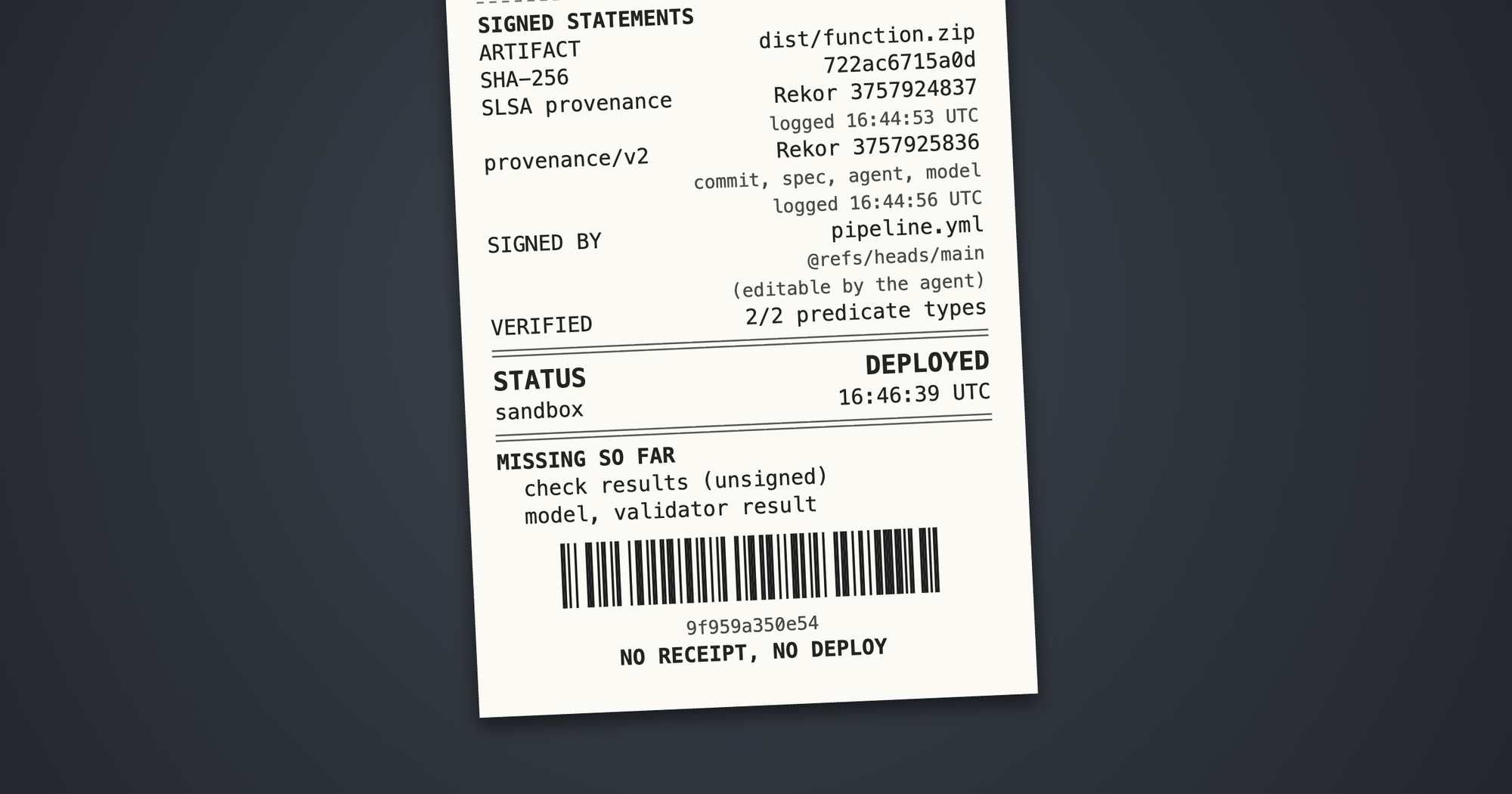
A SaaS product needs an update to its refunds subsystem so that customers who downgrade their plans get a prorated refund. An agent can build the refund change in a day. The change moves customer money. Do you let a coding agent make the refund change and ship it to production with no human review of the code?
Some teams use change advisory boards (CABs) for all changes. Others use CABs for large or select changes, human review for every pull request (PR) or both. While trusting the agent with no checks is fast, it is not safe. Human review can find problems, but it is unreliable. Also, each change can wait minutes, hours or even days for a reviewer before it deploys.
Teams need evidence instead. Each change gets a digital receipt, signed by the pipeline. The receipt records the IDs of the specifications (specs) that humans approved. It also records the checks that ran against the exact artifact that deploys, and the agent and model that wrote the code. Anyone can find out who signed the receipt and whether anyone changed it after the pipeline signed it. Without a valid receipt, the refund change does not deploy to production.
A secure agentic software factory adds one rule to that loop: the agents can write any code, but they cannot ship it. Only a change with a receipt that meets the deploy policy reaches production. The deploy policy lists what a valid receipt must contain.
In this factory, humans make judgments once, upstream. They sign the specs that state intent. They also approve the factory itself: the pipeline, the checks, the deploy policy and the agent inputs.
The agent writes the code without the permissions to deploy it. Checks that the agent cannot change test each change against the signed spec. The receipt and the deploy policy decide what ships to production.
This post explains what a receipt captures and how the pipeline uses it to decide what reaches production. It shows a real receipt from my factory, including the gaps it reports. It also gives you an on-ramp: the first checks to add and how to record a human approval as evidence. It then shows how to replace that approval with automated checks over time.
1. Evidence used to be paperwork. Now it is the control.
In the worst organizations, there is no change management and no governance. In others, the process is bureaucratic and slow. Over the past decades, I worked with hundreds of enterprises, and many of them had CABs. The purpose of a CAB was to stop bad changes before they reached end users in production. A CAB also kept one person from being both the approver and the implementer.
At each meeting, the CAB walked through every change with a rubric and decided what reached production. However smart the people on the CAB were, they often did not have the context to decide whether to approve a change. Most CABs met every one or two weeks, so every change waited for the next meeting. The result was governance theater, in which box checking replaced change management.
The screenshot below shows an approval in ServiceNow, a common change management tool. It comes from a demo in the GitLab documentation. A pipeline asked for approval to deploy to production at 15:38:56. The approver changed the state to Approved at 15:47:20, about eight minutes later. The change request rates the risk as High, and the Comments field is empty.
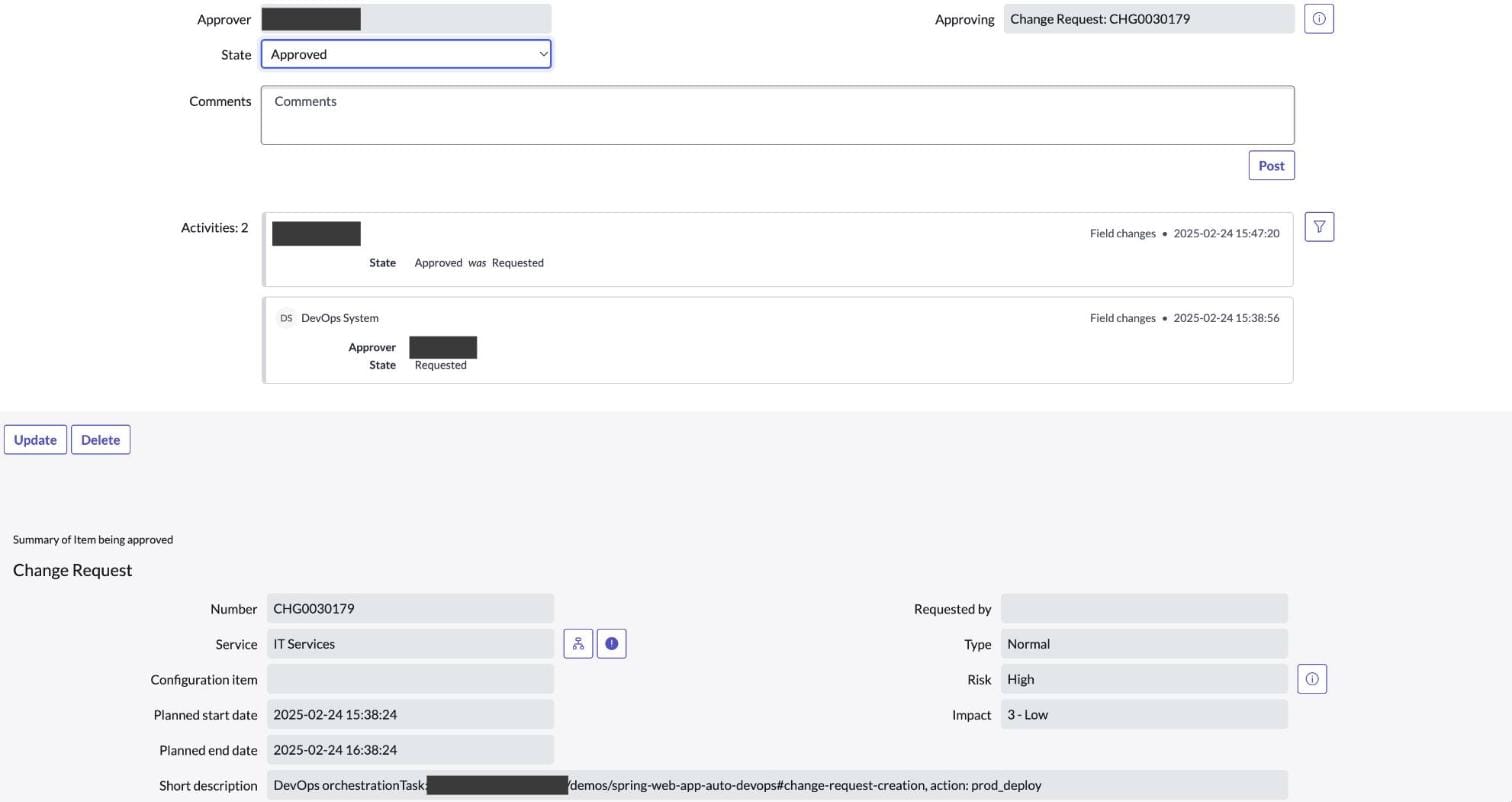
The approval shows who approved the change and when. It does not show what the approver examined, which checks ran or why a high-risk change was safe to deploy. A CAB approval records that a person said yes. It records nothing about the change itself.
When humans write all the code, teams often do not notice this inefficiency, or they accept it as necessary pain. With agents, some teams now push 10 times as many changes or more. At that volume, the change management problem is impossible to ignore. In May 2026, Anthropic averaged about 2,500 merged code changes a day in its monorepo. By September, it merged more than 30,000 a day. That is about 12 times as many in four months.
Your team might not be making as many changes as Anthropic. But if agents increase your number of changes, a board that meets every one or two weeks cannot keep up. Neither can a human review of every PR.
A CAB is like a batch inspection meeting that happens long after the line made the parts. By then, the defects are already in the parts. Lean manufacturing uses jidoka instead. Jidoka builds quality in at each step of the process, instead of inspecting it later. If a machine finds a defective part, the machine stops, and operators correct the problem before the part moves on.
For a CAB, evidence was documentation that people often skimmed. In an agentic software factory, evidence is the input to the deploy decision, and no person has to skim it.
2. What a receipt is
In manufacturing, a traveler is a document that moves with a part through every station. Each station records on the traveler what it inspected and that the part meets the specification.
At AI DevCon NYC 2026, I attended a talk by Daniel Meppiel called "Version your factory, not just your code." The talk used a receipt for every change as a key metaphor. That includes changes to your code and to the code and skills that define your factory. One part of the receipt is what he calls an agent bill of materials (ABOM). It lists the skills and packages that the agent received, each pinned by its content hash.
He also describes the idea in his post "Agent Contracts and Receipts." A contract states the intent and the checks before the agent starts. The receipt is the evidence that the run provides after it ends. The pipeline signs the receipt, and the agent cannot reach the signer.
His post names three roles: "Generation proposes. Verification evaluates. Policy authorizes." The receipt in my factory follows his post and his format draft 0.1, as decision 0002 in my repository records.
A receipt is the traveler for a software change. It is tamper-evident digital evidence of what ran and what the run produced. If anyone changes the receipt after the pipeline signs it, the signature no longer matches. The receipt records these items, among others:
- Each check that ran and its result. Examples are software composition analysis (SCA), secrets scanning, static application security testing (SAST) and mutation testing. SCA finds known vulnerabilities in open-source packages, secrets scanning finds passwords and keys in code, and SAST finds security flaws in source code. Mutation testing changes the code on purpose to see whether a test fails. In one run of the mutation check in my factory, the tests caught 57 of the 58 changes it made to
src/handler.ts. - The SHA-256 digest of the build artifact. It shows that the artifact did not change between build and deploy.
- The commit ID and the spec ID that the commit traces to, for example
SPEC-014-R7. - The agent and the model.
- Whether a human signed the spec.
- The results of the independent validator and of property tests. The independent validator is a separate agent that compares the code with the spec. It does not see the reasoning of the agent that wrote the code. A property test checks that a stated condition holds for many generated inputs.
- The signer. Only the pipeline signs the receipt.
The receipt in my factory
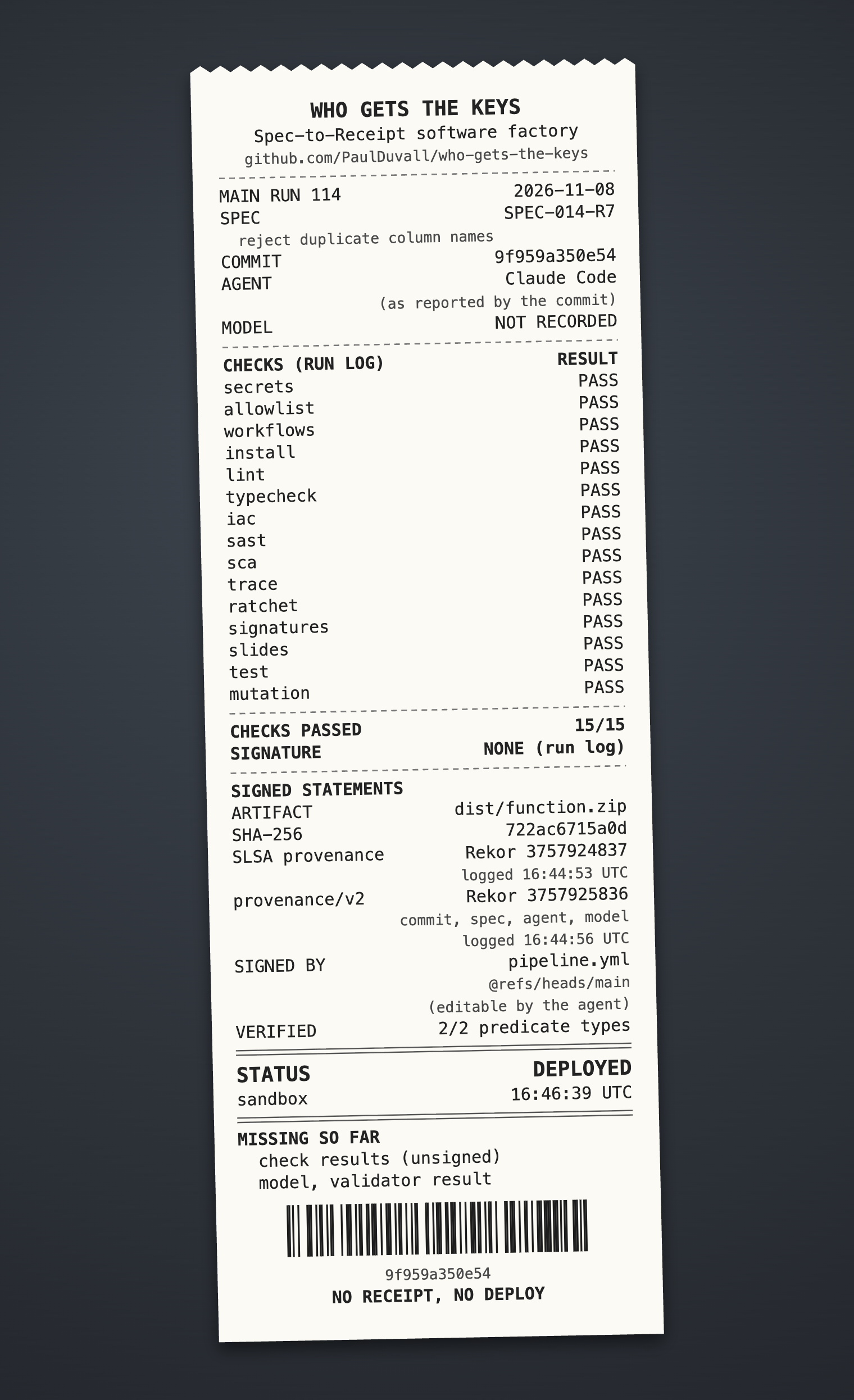
Here is the receipt from main run 114 of my factory. The pipeline signed two statements about the artifact, and Rekor, a public log, recorded each one. Together they record the build, the commit, the spec ID and the agent. The model field says "not recorded." All 15 checks passed, but those results come only from the run log, and nothing signed them. So the receipt is partial, and the change still deployed to the sandbox environment, as section 4 allows.
To produce this evidence, you can use SLSA for provenance, in-toto for attestations, Sigstore for digital signatures and Rekor for the transparency log. Provenance records how and where the pipeline built an artifact. An attestation is a signed statement about an artifact. SLSA provenance is one kind of attestation. A transparency log is a public record of signatures that nobody can change without detection.
The benefit of a receipt is an unbroken provenance chain. A human signs every spec and every change to the factory, including the factory pipeline that generates the application pipeline. The agents write code against those specs. The pipeline signs the result, and the receipt holds the evidence. So every change that deploys traces back to a human signature.
3. The ideal state, and one real receipt
In a factory, the operator records that each step is done, but the operator does not accept the part. A separate station accepts it. In an agentic software factory, the agent is the operator. The pipeline runs the checks that humans approved with the factory, and the pipeline signs the receipt. So the signer must be where the agent cannot change it.
In the ideal state, build, attest and deploy run in a reusable workflow in a separate signer repository. The application pipeline calls that workflow by commit SHA. The AWS deploy role trusts only the identity of that workflow. The agent can still change application code, but it cannot change the signer.
The second part of the ideal state decides what deploys. Deploy admission is the step that makes sure that a receipt meets the deploy policy before anything deploys. In a factory, receiving reads the certificate of conformance before a part goes into stock. A certificate of conformance is a document from the supplier that states that a lot meets the specification. Deploy admission makes sure of six things:
- The signature is valid.
- The signer is the one trusted signer.
- The artifact digest matches.
- The commit is the tip of main.
- Every spec ID traces to a signed spec.
- Every required check passed.
If any item fails, the deploy stops before it changes anything. The deploy step holds no signing key, so it cannot sign its own receipt.
Run 114's receipt
This is a real receipt from main run 114 of my factory, on November 8, 2026. Claude Code wrote a change that rejects duplicate column names, for requirement SPEC-014-R7. The pipeline printed this receipt before it deployed the change:
COMMIT   9f959a350e54
FILES    dist/function.zip sha256:722ac6715a0d
AGENT    Claude Code (as reported by the commit)
MODEL    not recorded
SPEC     SPEC-014-R7
SIGNED   pipeline.yml@refs/heads/main (editable by the agent)
VERIFIED 2/2 predicate types
The AGENT line comes from the commit, which the agent wrote. The receipt records it, but it does not treat it as proof. Two lines show gaps. SIGNED says editable by the agent because the signer is in the repository that it signs. MODEL says not recorded because its only source is a commit trailer, a line at the end of the commit message. The agent writes that line, and nothing attests it.
The receipt shows these gaps so that the deploy policy knows what it can rely on. The signed receipt has no check results and no validator result. The check results on the receipt in section 2 come from the run log, which nobody signs.
Why the signature is trustworthy
Three things make the signature trustworthy: the signer's identity, a public log and a signed policy.
The attest job, which signs the attestations, has no long-lived signing key. It exchanges its OIDC token, a short-lived identity token from GitHub Actions, for a certificate from Fulcio. Fulcio is the Sigstore certificate authority, and its certificates are valid for 10 minutes. The certificate names the repository, workflow, branch and commit. This is part of the certificate from run 114:
issuer                  https://token.actions.githubusercontent.com
subjectAlternativeName  https://github.com/PaulDuvall/who-gets-the-keys/.github/workflows/pipeline.yml@refs/heads/main
sourceRepositoryDigest  9f959a350e541d1aa52654e4ace7d7fdd4fa52a6
runInvocationURI        https://github.com/PaulDuvall/who-gets-the-keys/actions/runs/42501305077/attempts/1
Rekor records the signature in a public log. The provenance for run 114 is entry 3757924837, logged at 16:44:53 UTC. Nobody can backdate or remove an entry without detection.
A human signs the deploy policy, and the policy names the trusted signer. The human signs the policy one time, and deploy admission applies it to every deploy. In a factory, a quality engineer approves the control plan one time, and every part follows it. A control plan is the document that lists the required inspections for a part.
Browsers use the same model for HTTPS. A browser reads who issued a site's certificate and whose name is on it, so the user does not have to.
The receipt also records the result of the independent validator. In the ideal state, a validator failure stops the deploy. Section 4 describes how a team gets there.
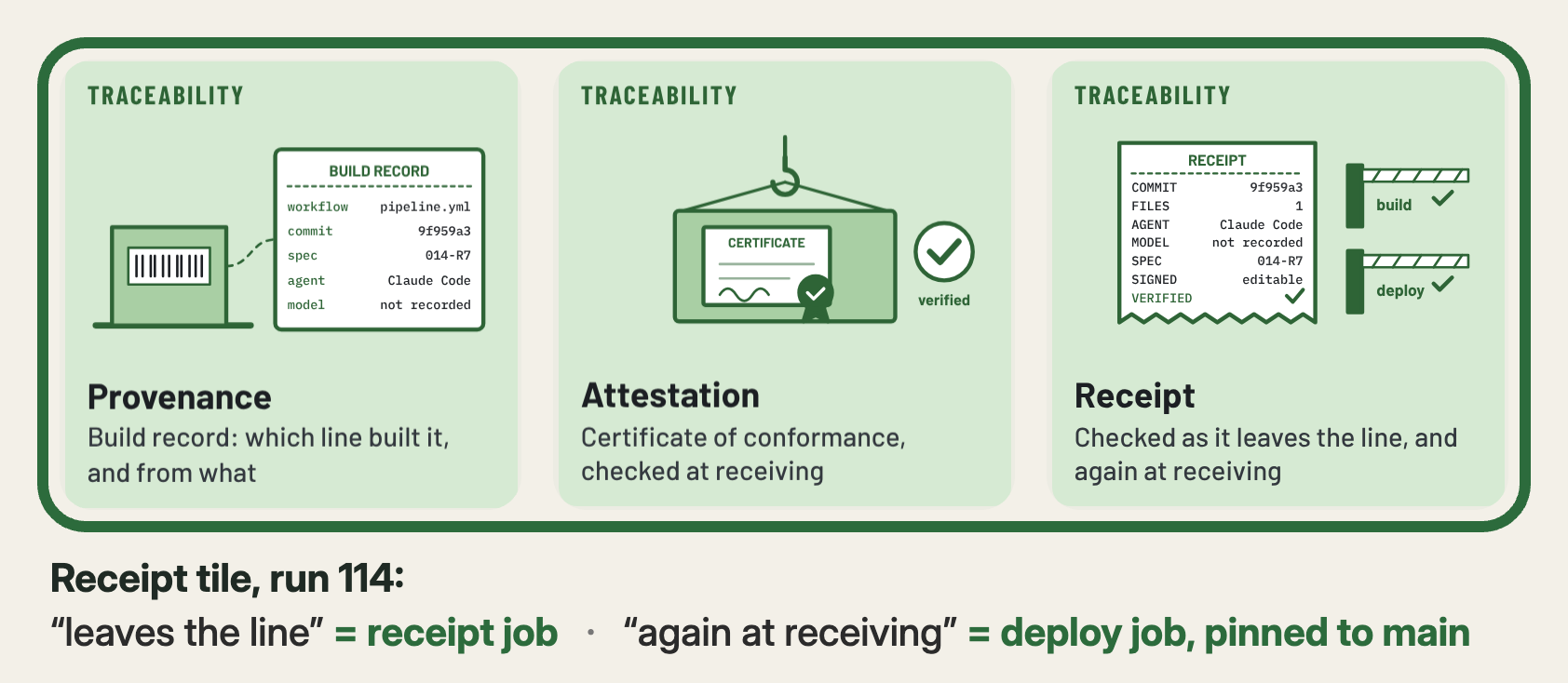
Run 114 applied the deploy policy twice: once in the receipt job, and again in the deploy job, pinned to main.
The three tiles below show where run 114 applied the deploy policy. They come from the Traceability column of the factory map in my post on the seven stages of securing the agentic software factory. That column holds the evidence: provenance, the attestation and the receipt. In the receipt tile, "leaves the line" is the receipt job, and "again at receiving" is the deploy job.
4. The on-ramp
Most teams do not start with the ideal state. They can start with less, because a receipt can be partly complete. A partial receipt deploys if it meets the deploy policy. The rule stays the same: only a change with a receipt that meets the deploy policy reaches production. Over time, the source of each line on the receipt changes. Some lines come from automated checks, and others come from a person.
Start with the checks that you already have. If you have no checks, add SCA and secrets scanning. Then add a signed approval line. The approval line records who approved the change, the time of the approval and the commit ID. Configure the pipeline to write a receipt with the result of each check and the approval line.
Human review covers what the checks do not cover yet. It is an acceptable workaround, but only if the receipt records it as evidence. The signed approval line is that evidence. Deploy admission reads the approval line the same way that it reads the SCA result. I made this point in my AI DevCon talk: "the approval becomes an input the pipeline checks."
Then tighten the deploy policy over time. Each manual approval is a candidate for automation. For each approval, find out what the approver looked for. Then write a check that looks for the same thing.
A new check can start as recorded only. The receipt holds the result, but a failure does not stop the deploy. When the team trusts the results, make the check block the deploy. The independent validator follows the same path. Over time, the deploy policy requires more lines on the receipt, and fewer changes need a human approval.
In a factory, an inspector signs the traveler at a station that is not automated yet. When the plant automates that station, a machine records the result instead. The approval line on the receipt is the signature of the inspector. It stays on the receipt until a check can record the same result.
5. How it goes bad
The risk is larger now for two reasons. Agents write the code, and people do not read every line. Also, agents and the systems around them get more access than anyone intended. In the 2026 OWASP Top 10 for LLM Applications, Excessive Agency moved from sixth to third. Excessive Agency means that an AI system has more permissions, functions or autonomy than its task needs.
In July 2025, the build configuration for the Amazon Q Developer extension for VS Code had a GitHub token with too much access. An attacker used the token to commit a prompt to the repository of the extension. The prompt told the Amazon Q agent to delete local files and cloud resources. The prompt went into an official release, version 1.84.0. The code did not run, because of a syntax error.
A receipt does not remove that access. An agent with too much access can still change code, run commands and publish files. It cannot make a valid receipt, because the signer is out of its reach. Stage 2 of The 7 Stages of Securing the Agentic Software Factory removes the access with a sandbox. In the sandbox, the agent has no keys, no authority and no write access to specs, the factory or main.
But a bad change can still go through the real pipeline, as the Amazon Q change did. The pipeline then signs a receipt for it. That is why the deploy policy also requires a spec that a human signed and every required check. Deploy admission refuses any change that does not meet the policy.
In the ideal state, receipts need four properties: integrity, non-repudiation, proof that the checks ran and provenance. The first two let deploy admission trust the receipt. The last two are what the receipt proves. Integrity means that the receipt is tamper-evident so that if anyone changes the built artifact or receipt after the pipeline signs it, the digest or the signature no longer matches. Non-repudiation means that the person who signed a spec or approved a change cannot deny it later. The agent cannot sign for that person, because its sandbox holds no keys. Proof that the checks ran demonstrates that SCA, secrets scanning and other checks ran against the same artifact that deploys to production, not just that someone said so. In an agentic factory, that someone can be the agent, so the receipt does not treat what the agent reports as proof. With provenance, the receipt shows which workflow built the artifact. Neither the agent nor an attacker with a stolen publish token can get the identity of that workflow. This prevents supply chain attacks in which attackers get bad code into the software that users install or use without going through the pipeline.
Each part of the receipt helps on its own, but deploy admission checks them together. The rest of this section shows what happens when a part is missing or when deploy admission checks only one part.
Skipping the pipeline
Clinejection was an attack on Cline, an open-source AI coding tool. The researcher Adnan Khan published it on February 9, 2026. Cline used an AI agent in GitHub Actions to sort new issues, and the workflow put each issue title into the agent's prompt. Any GitHub user was able to write an issue title that told the agent to run commands. This is prompt injection: text that gives an agent instructions that its owner did not write.
The triage workflow had no publish secrets, but it shared a GitHub Actions cache with the release workflows. Commands from the issue title put bad files in that cache, and the release workflows loaded them. That gave the attacker a way to steal the publish tokens. On February 17, 2026, someone used a stolen npm token that was still valid to publish cline@2.3.0. Users downloaded it about 4,000 times in eight hours.
That release did not go through the release pipeline. The attacker had the publish token but not the identity of the release workflow, so the attacker was not able to get a signed receipt. A check inside the Cline release pipeline never sees a package that skips that pipeline. So deploy admission must run where the package arrives: in the registry, or when each user installs it. Admission there refuses this package, because it has no receipt from the release workflow.
The agent loosens its own checks
An agent that can write to a branch can also change the pipeline file on that branch. My repository tests this case with scenario B18. The test adds one line to the step that runs every check:
continue-on-error: trueWith that line, a failed check no longer fails the job. The change has no signature from an approver, and the signatures check finds it:
CHECK signatures FAILED: unsigned change to .github/Today, the signatures check runs from the same pipeline file that the change edits. So in a live run, the new line also applies to the signatures check: it prints FAILED, but the job continues. The separate signer repository from section 3 closes that gap.
A replayed receipt
A real, signed receipt can still belong to a different change. My build is reproducible, which means that the same source makes the same bytes. Two commits that do not change the source make the same zip, with the same digest. On November 7, 2026, a test ran deploy admission for commit f6044ef. Deploy admission found an attestation from main for the same zip, but for an older commit, 13be9b2.
The signature was valid, and the branch was main. Deploy admission refused the attestation because the commit did not match:
expected BuildSignerDigest to be f6044ef…, got 13be9b2…An admission step that asks only whether the receipt is signed accepts this receipt. Deploy admission compares each field with the expected value, so it refuses it.
In a factory, receiving does not accept a lot that arrives without a certificate of conformance. Receiving also does not accept a certificate for a different lot. Deploy admission works the same way. It also works like jidoka, because it stops the deploy with no person involved. In all three examples, an automated step stops the change in the ideal state.
6. Sign once, deploy continuously
When the receipt meets the deploy policy, the pipeline deploys to production. The change does not wait for a CAB meeting or a review queue. Deploy admission makes sure of the six items in section 3.
This works only because humans made their judgments once, before the agents wrote code. An authorized person signed the spec that describes the intent. An authorized person also approved the factory: the pipeline, the checks, the deploy policy and the agent inputs. Every change that an agent makes goes through the factory and gets a receipt. Production logs then feed back into the next spec, and the loop closes without a person in every change.
That last part makes some people nervous. Without a final review, people worry that nobody catches the last defect. In Out of the Crisis (1982), W. Edwards Deming wrote: "Cease dependence on inspection to achieve quality." His point was to stop relying on mass inspection at the end of the line, and to build quality into the product from the start.
Toyota built the same idea into its line with jidoka. Every station can detect a defect and stop the line, so the team finds each problem where it started. The receipt is the evidence that each check ran. Secrets scanning runs in seconds, and SAST and SCA run in minutes. Mutation tests, property tests and the independent validator run after that. A single human review after an agent writes the code cannot match that rigor or that speed.
You do not have to start with no human approval. For risky changes, such as payments, authentication or irreversible data changes, keep a final human approval. The refund change from the start of this post is one of these. Record the approval as a signed approval line on the receipt, the same way that an inspector signs the traveler. Then track what the approvers find. If they keep finding nothing, that approval is a candidate for automation.
If a defect reaches production, treat it as an andon pull. An andon cord lets any worker on a Toyota line stop the line when there is a problem. Stop the line and fix the problem at its source. Find out which check missed the defect. Then add a check, or tighten the spec and the deploy policy, instead of adding another reviewer.
Over time, the amount of human review goes down. A human signs every change to the deploy policy, the same as every other part of the factory.
A change deploys when its receipt meets the deploy policy, the same way a part ships when its traveler is complete.